Turkish Keyboard Plugin
klye.plugin.tr
View detailed information for Turkish Keyboard Plugin — ratings, download counts, screenshots, pricing and developer details. See integrated SDKs and related technical data.

Screenshots


Description
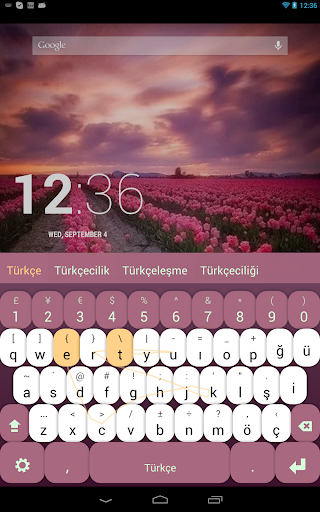
Turkish Dictionary plugin for Multiling O Keyboard autocorrect and word prediction
Instruction:
⑴ Install this plugin and Multiling O Keyboard. https://play.google.com/store/apps/details?id=kl.ime.oh
⑵ Run O Keyboard and follow its setup guide.
⑶ Slide space bar to switch languages.
If you have font issue, read this: http://honsoapps.appspot.com/1/ma.html
Wikipedia:
Turkish (About this sound Türkçe ), also referred to as Istanbul Turkish,[15] is the most widely spoken of the Turkic languages, with around 10–15 million native speakers in Southeastern Europe and 55–60 million native speakers in Western Asia. Speakers are located predominantly in Turkey, with smaller groups in Germany, Bulgaria, Macedonia, Northern Cyprus, Greece, the Caucasus, and other parts of Europe and Central Asia.
The roots of the language can be traced to the Altay region in the Eurasian steppes, with the first known written records dating back nearly 1,300 years. To the west, the influence of Ottoman Turkish—the variety of the Turkish language that was used as the administrative and literary language of the Ottoman Empire—spread as the Ottoman Empire expanded. In 1928, as one of Atatürk's Reforms in the early years of the Republic of Turkey, the Ottoman script was replaced with a Latin alphabet.
The distinctive characteristics of Turkish are vowel harmony and extensive agglutination. The basic word order of Turkish is subject–object–verb. Turkish has no noun classes or grammatical gender. Turkish has a strong T–V distinction and usage of honorifics. Turkish uses second-person pronouns that distinguish varying levels of politeness, social distance, age, courtesy or familiarity toward the addressee. The plural second-person pronoun and verb forms are used referring to a single person out of respect.