Subjective Vertical Test VR
indie.AlbuSorinCalin.EarTestVR
View detailed information for Subjective Vertical Test VR — ratings, download counts, screenshots, pricing and developer details. See integrated SDKs and related technical data.

Screenshots

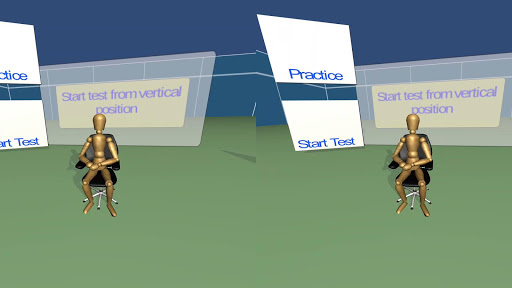


Description
The common goal of all eye movements is to facilitate a clear and stable view of the environment. But the brain cannot manage the data processing requirements of a visual system with high resolution across a large visual field. Frontal-eyed animals like humans have developed a small area of very high spatial resolution at the center of the retina (fovea), while maintaining lower settlement in the periphery. Mechanisms have also evolved to complement this foveal compromise strategy by ensuring that images of interest are bought and maintained on the foveae of both eyes. One of these mechanisms is the vestibulo-ocular reflex, mediated by the vestibular system, which helps to hold target images steady on the retina during brief head movements. The vestibular system is located in the inner ear and consists of three semicircular canals, the utricle, and the saccule. The vestibulo-ocular reflex can be subdivided into canal-ocular reflexes, with input from semicircular canals driving the angular VOR, otolith-ocular reflexes with the contribution of the utricle and the saccule driving the translational VOR, and the ocular counterrolling, which occurs in response to a change in the static orientation of the head with respect to the gravity in the frontal plane.
A lesion anywhere along the otolith-ocular pathway between the utricle and the midbrain can lead to the ocular tilt reaction. For example, a lesion of the left utricle disrupts the normally symmetric utricular input and leads to a shift in the patient`s internal estimate of absolute vertical (gravity) in the roll plane to the left. Thus, the brain erroneously registers that the head is tilted to the right with respect to gravity.
The purpose of this test is to detect abnormal subjective tilt. In normal persons, the ability to perceive verticality is quite good. This ability is dependent on input from visual, vestibular and somatosensory systems. It also depends on a functioning central nervous system. There are several types of subjective vertical. The subjective postural vertical is the position of the head with respect to true vertical.