UNIGE E-Smog
com.unige.unigeemf
View detailed information for UNIGE E-Smog — ratings, download counts, screenshots, pricing and developer details. See integrated SDKs and related technical data.
Screenshots

Description
This app was developed for a project on measuring non-ionizing radiation (e-smog) using smartphones. It was developed by the TCS Sensor Lab of the University of Geneva.
The measurements are limited to radiation from the following sources:
Wifis
Neighboring telephones
Bluetooth devices
As radiation indicator, RSSI values of the above sources are determined and cumulated.
We use a color scale from green for a low cumulated signal strength (lower than -75 dBm) to red for a high cumulated signal strength (higher than -40 dBm). Note that dBm is a logarithmic value that can be converted to watts.
Please note that in this experiment we do not claim to calculate an absolute value for non-ionizing radiation. Rather we are aware that the measured values are only approximate indicators. This is partly because not all devices may be detected and partly because the personal exposure to radiation depends on many factors that we do not measure here. For example, it depends on where on the body and how long a telephone is used, and also on one's own mobility. It is also possible that you have almost no network signal and that your own cell phone is a relatively high radiation source because it is searching for the network antenna.
However, we hope that by having as many participants in this project as possible, we can still detect a meaningful trend. That remains to be seen and therefore your participation is invaluable!
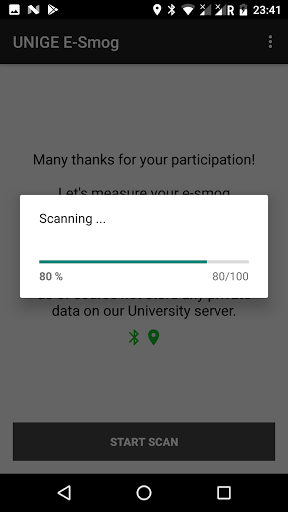
We are trying to achieve a best possible coverage with measurements of places like Geneva and Zurich and their surroundings. After a warm-up phase of the project, you will therefore receive about once a day a proposal in the form of a notification where a measurement is still needed. This proposal is initiated locally and is related to your last measurement. Note that we do not store your location on our server to generate these suggestions. There are no measurements running in the background without your knowledge.
In this project we are not interested in measuring your personal radiation exposure, but rather in whether there are conspicuous values at certain places, e.g. at the train station, in the library or at the airport on the escalator, or even in certain residential areas. To determine the e-smog level we access attributes of Android's CellInfo, BluetoothDevice, ScanResult, Build and TelephonyManager classes at the moment a measurement is made. The attributes are needed as the measured value depends for example on the network provider and this information is included in the Android classes. We also match the measurement's location to a cluster and limit zoom options to keep the data possibly private.
You can find more information about our project on https://crowd.unige.ch/e-smog.