Grade 12 Physical Science Book
com.quizover.app.course.col11244
View detailed information for Grade 12 Physical Science Book — ratings, download counts, screenshots, pricing and developer details. See integrated SDKs and related technical data.

Screenshots
Description
Siyavula textbooks: grade 12 physical science
* Complete Textbook by OpenStax
* Multiple Choices Questions (MCQ)
* Essay Questions Flash Cards
* Key-Terms Flash Cards
Powered by https://www.jobilize.com/
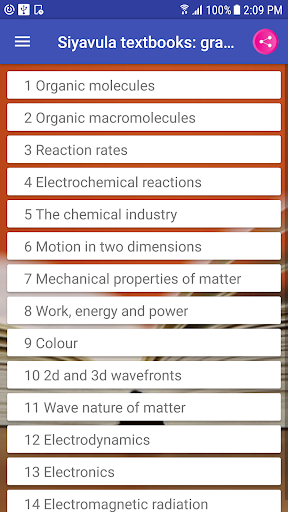
1. Organic molecules
1. Introduction and key concepts
1.1. Hydrocarbons
1.2. The alcohols
1.3. Carboxylic acids, amines and carboxlyic acid derivatives
1.4. Doppler effect
2. Organic macromolecules
2. Polymers
2.1. Biological macromolecules
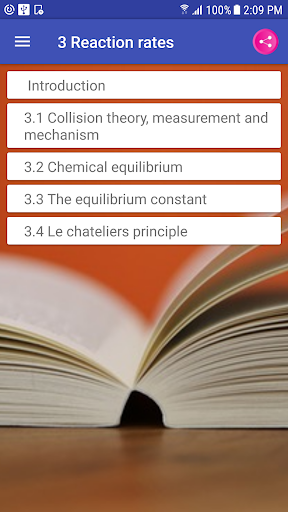
3. Reaction rates
3.1. Collision theory, measurement and mechanism
3.2. Chemical equilibrium
3.3. The equilibrium constant
3.4. Le chateliers principle
4. Electrochemical reactions
4. The galvanic cell
4.1. The electrolytic cell
4.2. Standard potentials
4.3. Balancing redox reactions
4.4. Applications
5. The chemical industry
5. Sasol
5.1. The chloralkali industry
5.2. The fertilizer industry
5.3. Electrochemistry and batteries
6. Motion in two dimensions
6. Vertical projectile motion
6.1. Conservation of momentum
6.2. Types of collisions
6.3. Frames of reference
7. Mechanical properties of matter
7. Deformation of materials
7.1. Failure and strength of materials
8. Work, energy and power
8.1. Energy
8.2. Power
9. Colour
9. Colour and light
9.1. Paints and pigments
10. 2d and 3d wavefronts
10. Wavefronts, huygen's principle and interference
10.1. Diffraction
10.2. Shock waves and sonic booms
11. Wave nature of matter
11. De broglie wavelength
11.1. Electron microscopes
12. Electrodynamics
12. Generators and motors
12.1. Alternating current, inductance and capacitance
13. Electronics
13. Capacitive and inductive circuits
13.1. Principles of digital electronics
13.2. Active circuit elements
14. Electromagnetic radiation
14. Wave nature and particle nature
14.1. Penetrating ability
15. Optical phenomena and properties of matter
15. Transmission and scattering of light
15.1. Photoelectric effect
15.2. Emission and absorption spectra
15.3. Lasers