iBuoy
com.ntu.ibuoy2025
View detailed information for iBuoy — ratings, download counts, screenshots, pricing and developer details. See integrated SDKs and related technical data.
- No items.

Screenshots


Description
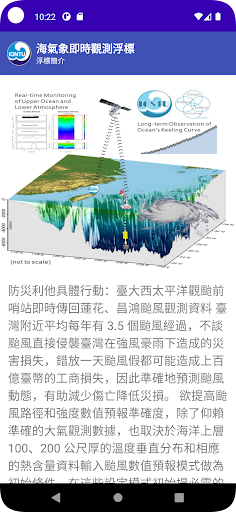
An average of 3.5 typhoons pass through Taiwan every year. Not to mention the disaster losses caused by strong winds and heavy rains when typhoons directly hit Taiwan, even a single day of typhoon holiday may result in industrial and commercial losses of over NT$10 billion. Therefore, accurately predicting typhoon dynamics will help reduce casualties and minimize disaster losses.
To improve the accuracy of numerical forecasts of typhoon paths and intensities, in addition to relying on accurate atmospheric observation data, it is also necessary to input the vertical distribution of temperature and the corresponding heat content data in the upper 100 to 200 meters of the ocean into the typhoon numerical forecast model as initial conditions. Among the observation data required for setting the initial field of the model, the upper ocean temperature profile is the most difficult to obtain. It is impossible to rely on research ships to conduct observations in the sea areas where the typhoon may pass before the typhoon arrives. The solution is to deploy ocean and atmospheric observation buoys in hot spots along the typhoon's route, and transmit the observation data back to research and forecasting units via communication satellites at any time for use.