Deewan e Ghalib - Mirza Ghalib
com.cssstylekit.diwan_e_ghalib
View detailed information for Deewan e Ghalib - Mirza Ghalib — ratings, download counts, screenshots, pricing and developer details. See integrated SDKs and related technical data.
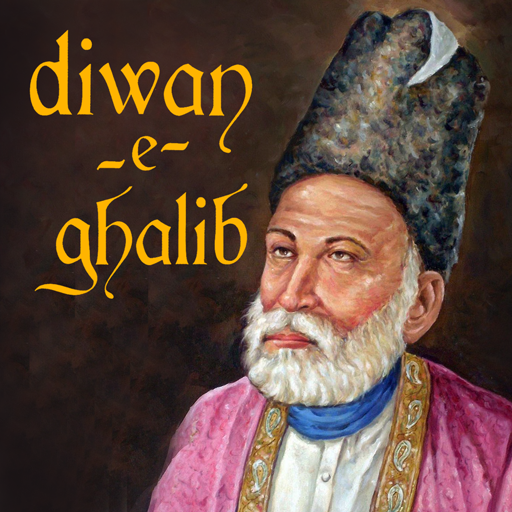
Screenshots

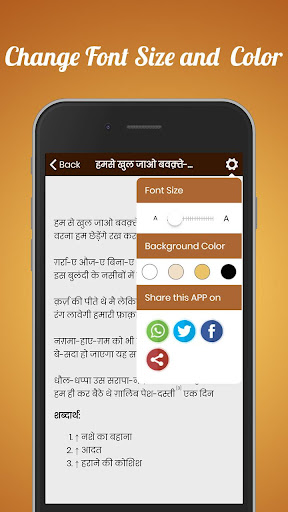
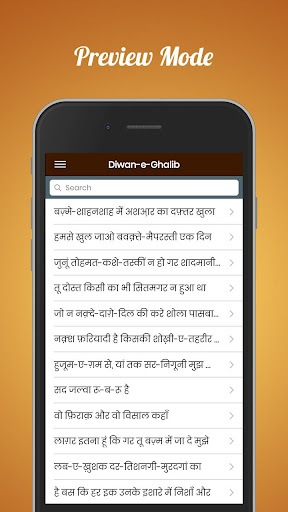
Description
Ghalib (Urdu: غاؔلِب, Hindi: ग़ालिब), born Mirza Asadullah Baig Khan (Urdu: مِرزااسَدُاللہ بیگ خان, Hindi: मिर्ज़ा असदुल्लाह् बेग ख़ान), 27 December 1797 – 15 February 1869),[1] was a prominent Urdu and Persian-language poet during the last years of the Mughal Empire. He used his pen-names of Ghalib (Urdu: غالِب, ġhālib means "dominant") and Asad (Urdu: اسَد, Asad means "lion"). His honorific was Dabir-ul-Mulk, Najm-ud-Daula. During his lifetime the Mughals were eclipsed and displaced by the British and finally deposed following the defeat of the Indian rebellion of 1857, events that he described.[3] Most notably, he wrote several ghazals during his life, which have since been interpreted and sung in many different ways by different people. Ghalib, the last great poet of the Mughal Era, is considered to be one of the most famous and influential poets of the Urdu language. Today Ghalib remains popular not only in India and Pakistan but also among the Hindustani diaspora around the world.
Mirza Ghalib was born in Kala Mahal, Agra into a family descended from Aibak Turks who moved to Samarkand(in modern-day Uzbekistan) after the downfall of the Seljuk kings. His paternal grandfather, Mirza Qoqan Baig, was a Saljuq Turk who had immigrated to India from Samarkand during the reign of Ahmad Shah (1748–54).[citation needed] He worked at Lahore, Delhi and Jaipur, was awarded the subdistrict of Pahasu (Bulandshahr, UP) and finally settled in Agra, UP, India. He had four sons and three daughters. Mirza Abdullah Baig and Mirza Nasrullah Baig were two of his sons.
Mirza Abdullah Baig (Ghalib's father) married Izzat-ut-Nisa Begum, an ethnic Kashmiri, and then lived at the house of his father-in-law. He was employed first by the Nawab of Lucknow and then the Nizam of Hyderabad, Deccan. He died in a battle in 1803 in Alwar and was buried at Rajgarh (Alwar, Rajasthan). Then Ghalib was a little over 5 years of age. He was raised first by his Uncle Mirza Nasrullah Baig Khan.
At the age of thirteen, Ghalib married Umrao Begum, daughter of Nawab Ilahi Bakhsh (brother of the Nawab of Ferozepur Jhirka).[citation needed] He soon moved to Delhi, along with his younger brother, Mirza Yousuf , who had developed schizophrenia at a young age and later died in Delhi during the chaos of 1857.
In accordance with upper class Muslim tradition, he had an arranged marriage at the age of 13, but none of his seven children survived beyond infancy. After his marriage he settled in Delhi. In one of his letters he describes his marriage as the second imprisonment after the initial confinement that was life itself. The idea that life is one continuous painful struggle which can end only when life itself ends, is a recurring theme in his poetry. One of his couplets puts it in a nutshell:
قید حیات و بند غم ، اصل میں دونوں ایک ہیں
موت سے پہلے آدمی غم سے نجات پائے کیوں؟
Transliteration in Hindi
क़ैद-ए-हयात-ओ-बंद-ए-ग़म, अस्ल में दोनों एक हैं
मौत से पहले आदमी ग़म से निजात पाए क्यूँ?
His original Takhallus (pen-name) was Asad, drawn from his given name, Asadullah Khan. At some point early in his poetic career he also decided to adopt the pen-name of Ghalib (meaning all conquering, superior, most excellent). At some places in his poetry Ghalib also used the pen name of Asad Ullah Khan.
diwan-e-ghalib
mirza ghalib
deewan e ghalib
ghalib poetry
ghalib shayari
ghalib
mirza ghalib shayari
ghazals of ghalib
mirza ghalib books
deewan e ghalib mirza ghalib shayari in hindi
mirza ghalib shayari in hindi pdf
mirza ghalib poetry
deewan e ghalib pdf
mirza ghalib ghazals
ghalib books
ghalib shayari in hindi
ghalib sher
diwan e ghalib in hindi
divan e ghalib
ghalib poetry in urdu
selected poetry of ghalib
diwan e ghalib pdf
deewan e ghalib in hindi
mirza ghalib shayari in urdu
mirza ghalib shayari in hindi books