직선도선 주위 자기장 가상실험 2
air.com.sciencelove.Magneticfield2
View detailed information for 직선도선 주위 자기장 가상실험 2 — ratings, download counts, screenshots, pricing and developer details. See integrated SDKs and related technical data.
- No items.

Screenshots

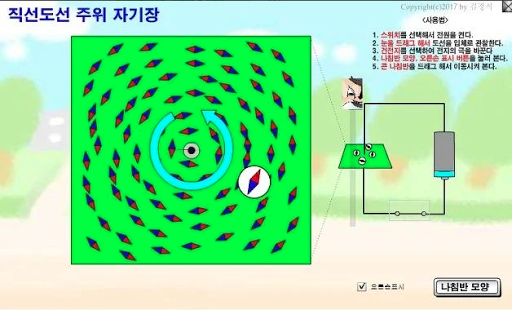

Description
I made a three-dimensional magnetic field around a straight wire.
It was a simple fact that I was teaching, but the students tended not to match the pictures in the textbook with the view from the top and the view from the side.
So I made it so that I could see it while adjusting the angle to look intuitively.
1. The flowing straight wire can be observed from the top, side, or bottom.
(You can drag the eye shape up and down.)
2. You can experiment with electricity when it flows and when it does not.
(Press the switch.)
3. You can also change the direction of the current.
(Pressing the battery automatically changes the direction.)
4. You can observe the shape of the magnetic field by changing it into iron powder, arrow, or compass. The direction of the magnetic field is the line connecting the direction of the N pole of the compass. It is made of a compass and it does not seem intuitively understood. So I showed it in the shape of an arrow.
(The shape changes each time you press the compass button.)
5. Click the right hand mark to check that the right hand is displayed on the wire, and you can see how the magnetic field around the straight wire is formed.
(Check it before you turn it on, press the right-hand display to show it, and then press the switch to turn it on and see if it's what you expected.)
Especially, it is good to compare the angle of the observer with that of the current when the angle is changed.
You can download it for computer use from the link below.
http://sciencelove.com/2175